
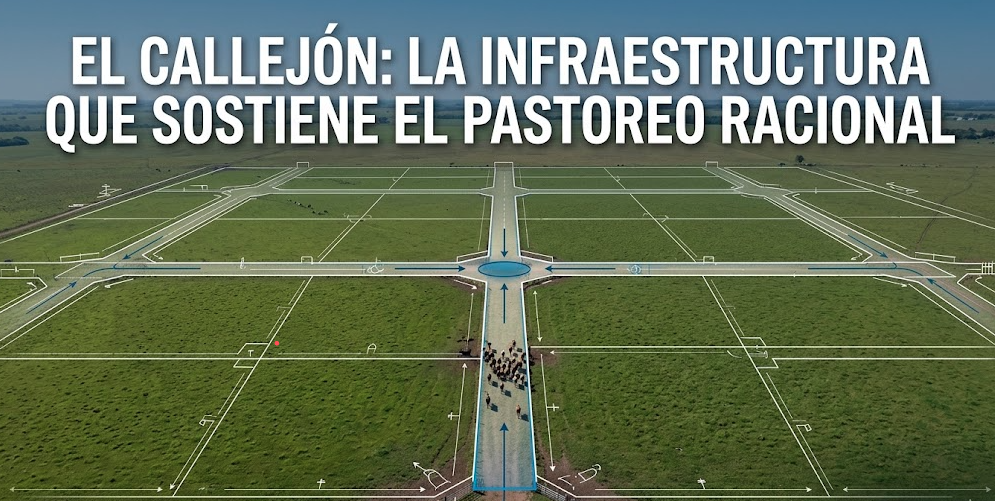
The alley: the infrastructure that supports rational grazing
There is an operating principle that is often counterintuitive for those who are new to rational grazing: when in doubt between subdividing a pasture or building an alley, it is advisable to prioritize the alley.
The logic seems to be reversed. It is assumed that the productive value is in the plot, in the pasture. However, field experience shows that without resolute circulation logistics, no grazing system can be sustained over time.
The invisible cost of poor circulation design
Moving 500 animals from one end of the establishment to the other, crossing foreign lots, opening and closing multiple doors, with the dispersion of the farm and the delay of staff, has specific economic consequences that are rarely counted:
- Staff attrition, which ends up resisting the system.
- Animal stress, with the release of cortisol and a drop in daily weight gain.
- Loss of productive hours on low-complexity tasks.
The alley is not an auxiliary path: it is the vertebral column that articulates production. This is what allows a management decision - moving the farm to lot 4, for example - to be executed in fifteen minutes in an orderly manner, instead of turning into a multi-hour operation.
The energy expenditure of walking
Behind the design of alleys there is an often underestimated economic variable: the energy cost of animal movement.
Each meter traveled involves the consumption of metabolizable energy. That energy comes from the forage consumed. If it is intended for walking instead of being converted into meat, the efficiency of the system deteriorates.
Proper alley layout reduces distances between the plot, water and management points. This translates into lower energy expenditure per animal and, consequently, in higher productivity per hectare.
Agile infrastructure, not civil engineering
A common mistake is to associate the concept of “alley” with fixed seven-wire fencing, jigger poles and ground movements. That approach is unnecessarily costly and rigid.
At Pensagro, we propose a model of agile and functional alleys, based on three principles:
- Dynamism: they are armed with rods and spools, allowing temporary or semi-permanent configurations.
- Adaptability: the layout can be modified depending on forage planning or seasonality.
- Capital efficiency: investment is made in reusable mobile inputs, without immobilizing capital in fixed infrastructure.
Conclusion
The alley is the tool that enables operational flexibility. It allows the farm to be moved when the state of the grass requires it, and not when logistical conditions allow it. It also allows a single operator to handle hundreds of heads efficiently.
For those who already have an electrifier installed, the next strategic investment is not necessarily to expand the rodeo: it is to build the circulation infrastructure that allows that rodeo to flow.
At Pensagro, we offer the rods, insulators and spools needed to design efficient, economic and durable alleyways. Consult us to plan the circulation of your establishment.