
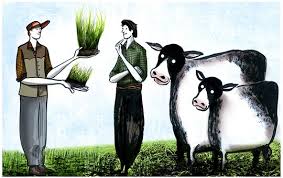
90% of the business is in the grass: why rest is the most profitable variable in the system
It is important to be direct: most livestock producers are fluent in reading the animal, but not the reading of the forage resource. Hours are spent evaluating body condition, coat condition and conformation, while the food factory—the grass and the soil—is relegated to the background.
In a pasture farming system, the cow represents approximately 10% of the productive equation. The remaining 90% is in the grass and the soil that supports it. When that 90% fails, no genetic decision compensates for the loss.
This article addresses a common and poorly quantified phenomenon: the anticipated consumption of one's own forage production before it reaches its potential.
The sigmoid curve of forage growth
Grass doesn't grow linearly. Its accumulation of dry matter responds to a sigmoid curve with three clearly differentiated phases:
- Initial phase: the plant is defoliated and mobilizes root reserves to generate new leaf area. Growth is slow and biomass accumulation is minimal.
- Exponential growth phase: with sufficient active leaf surface, the plant maximizes the photosynthetic rate and produces the largest volume of green matter with the best leaf/stem ratio.
- Senescence phase: the plant lignifies, loses digestibility and its nutritional quality deteriorates.
The most common mistake in traditional management is to keep the animal permanently grazing on early-stage plants.
Regrown consumption: a hidden high-impact cost
When the farm spends too many days in the same paddock—or returns prematurely— it selects and consumes the tender regrowth that just emerges.
In doing so, it interrupts the recovery process just as the plant was trying to reconstitute its reserves. The result is a cycle of progressive degradation: the plant fails to develop sufficient leaf area, its roots shorten, the soil loses cover and the productive capacity of the lot falls systematically year after year.
In economic terms, the future production of the system is currently being consumed.
Rest as a management variable
For forage to enter the phase of exponential growth, where the accumulation of dry matter multiplies, only one condition is required: adequate rest time without animal presence.
The productive difference is significant:
- With continuous grazing on regrown: typical productions of around 1,000 kg of dry matter per hectare.
- With adequate rest and harvest at the optimal time: yields of up to 4,000 kg of dry matter per hectare, on the same lot and with the same rainfall regime.
The difference does not come from an additional input, but from a management decision.
Managing time, not just space
The main management variable in a rational grazing system is not what the animal eats, but rather how long it stays in each lot and how long the forage is allowed to rest.
To carry out this management, subdivision infrastructure is required that allows for agile rotations: short occupancy times and extended rest times per plot. It's not about working harder, but about working with clear technical criteria.
Conclusion
Before making decisions about genetics, supplementation or extension of the rodeo, it is advisable to audit a more basic and higher-return variable: the effective rest days in each batch.
At Pensagro, we offer the necessary spools, rods and electrifiers to implement a simple and efficient rotation system that can transform time management into forage productivity.